Botanical ingredients with a rigorous, multi-stage evidence base remain relatively uncommon in the weight management category. Theolim, a proprietary plant-derived ingredient developed by NaturMed Scientific, has been evaluated across a sequence of preclinical and clinical research. This article summarises what the published evidence currently suggests, what it does not show, and why the safety profile is relevant to consumers.
What Is Theolim?
Theolim is a standardised, patented combination of two plant-derived extracts: the rind of Key lime (Citrus aurantifolia) and the seed of Cocoa (Theobroma cacao), blended at a 2:1 ratio. Both source materials are widely consumed foods with long histories of human use. The finished ingredient is standardised to minimum levels of citric acid (5.0%), theobromine (0.5%), and hesperidin (0.3%), and is produced in a certified Good Manufacturing Practice facility (Kundimi et al., 2024).
The formulation was selected following a systematic screening process in which over 1,000 botanical extracts were evaluated. The combination of the two extracts was found to produce effects greater than either ingredient in isolation, a property referred to in pharmacology as synergy (Kundimi et al., 2024).
Stage 1: Cell and Animal Research

In a proof-of-concept study published in the Journal of the American Nutrition Association, Kundimi et al. (2024) investigated Theolim in mouse fat cell cultures and in an animal model of diet-induced obesity. In fat cells, Theolim was observed to support the production of fibroblast growth factor-21 (FGF-21), a metabolic signalling protein involved in energy regulation, and to support the expression of uncoupling protein-1 (UCP-1) and the beta-3 adrenergic receptor (β3-AR), both proteins associated with thermogenic activity in adipose tissue. These effects were observed to a greater degree with the combined extract than with either ingredient alone (Kundimi et al., 2024).
Also Read: Sports Nutrition Solutions
In rats fed a high-fat diet, oral supplementation over 28 days was associated with a dose-dependent increase in resting energy expenditure and reductions in body weight gain and total fat mass compared to unsupplemented animals. Food intake did not differ significantly between groups during this period (Kundimi et al., 2024). As with all animal research, these findings cannot be directly applied to human outcomes and are best understood as preliminary mechanistic evidence.
Stage 2: Acute Human Crossover Trial

The first human study was a randomised, double-blind, placebo-controlled crossover trial involving 60 overweight adults aged 20 to 39 years (BMI 25 to 29.9 kg/m²), published in Food & Nutrition Research (Ammatalli et al., 2024). Participants received a single 450 mg capsule of Theolim or a matched placebo, and resting metabolic rate (RMR) was measured using indirect calorimetry at 60, 120, and 180 minutes post-dose, as well as during and after a session of moderate exercise the following day.
RMR in the Theolim group was statistically significantly higher than placebo at the 120-minute and 180-minute time points. Fat oxidation, the rate at which the body utilises fat as a fuel source, was also observed to be significantly higher in the Theolim group at rest and in the 20 minutes following exercise, compared to placebo (Ammatalli et al., 2024).
Also Read: How Fermentation Improves the Bioavailability of Botanical Compounds
Blood pressure and heart rate did not differ meaningfully between groups across either condition, and all values remained within normal physiological ranges throughout. Participants in the Theolim group also recorded lower scores on a validated mood disturbance questionnaire during exercise compared to the placebo group (Ammatalli et al., 2024). No adverse events were reported. The authors note this was a short-term study, and that longer-term research would be needed to assess sustained effects.
Stage 3: 16-Week Randomised Controlled Trial
The most substantial human evidence to date comes from a randomised, double-blind, placebo-controlled, multi-centre trial in 120 overweight adults aged 25 to 55 years, published in Food & Nutrition Research (Chadalavada et al., 2025).
Participants received either 450 mg/day of Theolim or a matched placebo for 16 weeks, followed their habitual diets, and were asked to walk for 30 minutes five days per week. Calorie intake was monitored throughout and did not differ significantly between groups.
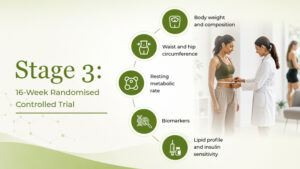
Body weight and composition: After 16 weeks, people who took Theolim lost more weight on average (about 4.25 kg) than those who took a placebo (about 1 kg). They also had a bigger drop in body fat (about 4.28 kg vs 0.85 kg), and their BMI went down more. Muscle mass stayed mostly the same, with a tiny increase in the Theolim group and a small decrease in the placebo group (Chadalavada et al., 2025).
Waist and hip circumference: Waist circumference was reduced by a mean of 4.32 cm in the Theolim group versus 2.10 cm in placebo, and hip circumference by 3.16 cm versus 1.31 cm respectively, both statistically significant versus placebo at week 16 (Chadalavada et al., 2025).
Resting metabolic rate: Resting metabolic rate increased from pre-dose baseline by a mean of 459 kcal/day in the Theolim group at week 16, compared to approximately 102 kcal/day in the placebo group (p < 0.001 vs. placebo). The respiratory exchange ratio was also significantly reduced in the Theolim group at weeks 8 and 16, which may suggest a relative increase in fat utilisation as an energy source, though the clinical interpretation of this measure in isolation is limited (Chadalavada et al., 2025).
Biomarkers: Serum GLP-1, a hormone involved in appetite regulation and metabolic function, increased by approximately 33% from baseline in the Theolim group at week 16 (p < 0.001 vs. baseline; p < 0.05 vs. placebo). Serum adiponectin increased by approximately 52% from baseline, while ghrelin decreased significantly compared to both baseline and placebo.
Lipid profile and insulin sensitivity: LDL cholesterol, the LDL/HDL ratio, and HOMA-IR, a marker used to estimate insulin resistance, were all reduced significantly in the Theolim group at week 16 versus placebo (Chadalavada et al., 2025).
The broader clinical significance of these biomarker changes in the context of a food supplement requires further independent investigation.
No serious adverse events were recorded. Minor events such as headache, nausea, and cough were comparable between groups, and all haematological and biochemical parameters remained within normal ranges throughout (Chadalavada et al., 2025).
Preclinical Safety Assessment
Preclinical safety studies conducted under OECD guidelines found no evidence of significant toxicity or genetic damage associated with Theolim at the tested doses. High-dose and longer-term animal studies reported no serious adverse effects or meaningful abnormalities in health markers, organ function, or tissue structure (Kundimi et al., 2023).
Context and Limitations
The clinical trials were conducted in India and were partly industry-sponsored. While registered and published in peer-reviewed journals following Good Clinical Practice guidelines, independent replication in European populations would add confidence in the findings. The trials enrolled overweight adults with BMIs between 25 and 29.9 kg/m², and results may not apply to individuals outside this range or with significant health conditions. Effects were observed alongside a habitual diet and modest walking programme (Chadalavada et al., 2025).
Note: Theolim is a food supplement ingredient, not a licensed medicinal product, and is not intended to diagnose, treat, cure, or prevent any disease. Consumers with pre-existing health conditions or those taking medication are advised to consult a qualified healthcare professional before use.
References
Ammatalli, N.K.R., Kuricheti, S.S.S.K., Veeramachaneni, S., Koo, Y.K., Ramanathan, G. and Yalamanchi, A. (2024) ‘A combination of Citrus aurantifolia fruit rind and Theobroma cacao seed extracts supplementation enhances metabolic rates in overweight subjects: a randomized, placebo-controlled, cross-over study’, Food & Nutrition Research, 68, article 10745. Available at: https://doi.org/10.29219/fnr.v68.10745
Chadalavada, A., Koo, Y.K., Kim, S., Veeramachaneni, S., Ramanathan, G. and Yalamanchi, A. (2025) ‘A thermogenic botanical composition containing Citrus aurantifolia fruit rind and Theobroma cacao seed extracts improves body composition in overweight adults: a clinical investigation’, Food & Nutrition Research, 69, article 12159. Available at: https://doi.org/10.29219/fnr.v69.12159
Kundimi, S., Chinta, G., Alluri, K.V., Golakoti, T., Veeramachaneni, S., Ramanathan, G. and Sengupta, K. (2023) ‘Preclinical safety evaluation of LN19183: acute, subchronic, dermal, ocular and genotoxicity studies’, unpublished manuscript, Laila Nutraceuticals R&D Centre, Vijayawada, India.
Kundimi, S., Chinta, G., Alluri, K.V., Golakoti, T., Veeramachaneni, S., Ramanathan, G. and Sengupta, K. (2024) ‘A synergistic botanical composition increases resting energy expenditure and reduces adiposity in high-fat diet-fed rats’, Journal of the American Nutrition Association, 43(3), pp. 286–295. Available at: https://doi.org/10.1080/27697061.2023.2280777
Disclaimer: The Statement has not been evaluated by the EFSA, KFDA or FDA. This product is not intended to diagnose, treat, cure, or prevent any disease. While the information provided is based on credible references, we do not make any specific claims or guarantees. It is important to consult with your healthcare advisor for personalized advice and guidance related to your health.