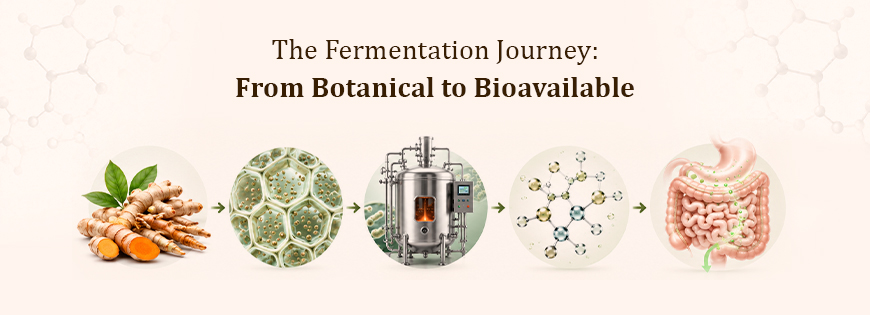
Many of the most researched compounds in botanical nutrition, from curcuminoids to withanolides, share a common limitation: the body struggles to absorb them efficiently in their raw form. Fermentation, one of the oldest food processing techniques known to humans, is increasingly being re-examined by nutraceutical science as a way to address this problem. This article looks at how fermentation changes botanical compounds at a molecular level, what published research reports about its effects on bioavailability and bioactivity, and how NaturMed Scientific applies this process through its Fermiva platform.
Also Read: Benefits of Milk Thistle for Liver and Blood Sugar
Why Bioavailability Is a Problem for Raw Botanicals
Bioavailability refers to the proportion of a compound that is absorbed into the bloodstream and available to act on the body after consumption. Many valuable plant compounds, particularly polyphenols, are naturally bound within complex plant matrices in forms such as tannins, anthocyanins, and glycosides. These large, bound structures are difficult for the human digestive system to break down efficiently. A 2023 review in the journal Foods reports that, in their unmodified form, only around 5–10% of dietary polyphenols are absorbed into the body, with the remainder passing into the colon (Yang et al., 2023).
What Happens to Botanicals During Fermentation
Fermentation uses microorganisms, most commonly lactic acid bacteria, yeasts, and select fungal strains, to metabolise plant material over a controlled period. Microbial enzymes such as tannases, esterases, and glycosidases break down the larger, bound compounds in the plant matrix into smaller, more absorbable forms (Yang et al., 2023). This biotransformation is associated with several measurable, study-documented changes:
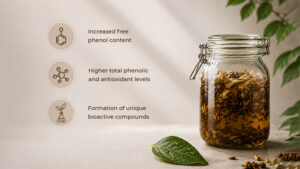
- Increased free phenol content. In legume sprouts fermented with lactic acid bacteria, isoflavone content increased roughly fivefold, from 1.1 g to 5.5 g per 100 g dry weight, following fermentation (Yang et al., 2023).
- Higher total phenolic and antioxidant levels. In one study of spontaneously fermented black wolfberry, total phenolic content rose by approximately 43% after 60 days of fermentation, alongside a corresponding increase in free-radical scavenging activity (Yang et al., 2023). A separate study of fermented sea buckthorn leaves reported total phenolic content increasing by around 79%, from roughly 56 mg to 100 mg gallic acid equivalents per gram, following fungal fermentation (Yang et al., 2023).
- Formation of unique bioactive compounds. Beyond polyphenols, fermentation has also been associated with the formation of additional bioactive metabolites not present in the unfermented material, further diversifying the functional profile of the finished ingredient (Khayatan et al., 2024).
These figures come from studies on specific fermented foods and substrates; the magnitude of change varies considerably depending on the raw material, the microbial strain used, and the fermentation conditions applied.
Also Read: Curcumin: A Review of Its Effects on Human Health
Fermentation and Anti-Inflammatory Activity
Alongside changes in polyphenol composition, fermentation has been linked to enhanced anti-inflammatory and immunomodulatory properties in plant-derived foods (Shahbazi et al., 2021). This is attributed to several interacting factors:
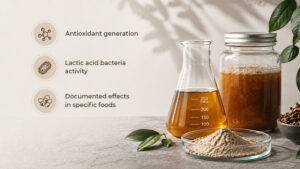
- Antioxidant generation. Antioxidant compounds formed during fermentation neutralise free radicals, regulate antioxidant enzyme activity, and reduce oxidative stress, contributing to the anti-inflammatory profile of fermented plant foods (Shahbazi et al., 2021).
- Lactic acid bacteria activity. These microorganisms support a healthy gut microbiota composition and contribute to local and systemic immune function. Kimchi, for example, has been reported to retain around 10⁸–10⁹ colony-forming units of lactic acid bacteria per gram after fermentation (Shahbazi et al., 2021).
- Documented effects in specific foods. In animal studies cited in the same review, fermented blueberry preparations reduced markers such as nitric oxide and TNF-α release in stimulated immune cells, while fermented soy products reduced inflammatory cytokine signalling in high-fat-fed models (Shahbazi et al., 2021).
Also Read : Cinnamon: Health Benefits and Side Effects
Fermentation, Metabolic Markers, and Reduced Toxicity

Research on fermented botanical drugs more broadly has explored effects extending into anti-diabetic, hypolipidemic, and detoxifying properties (Luo et al., 2024). Key findings include:
- Improved glucose and lipid markers. In high-fat-diet rat models, fermented ginseng preparations were associated with statistically significant reductions in adipocyte size (p < 0.01) and abdominal fat pad weight (p < 0.05), alongside reduced LDL cholesterol and triglycerides and increased HDL cholesterol (Luo et al., 2024).
- Reduced toxicity. Fermentation has been associated with reduced toxic side effects in certain botanical preparations, alongside enhanced pharmacological activity (Luo et al., 2024).
- Shared underlying mechanism. These effects are attributed to the same core process described above: microbial transformation of raw plant material into more bioactive, more readily absorbed compounds (Luo et al., 2024).
As with the bioavailability data above, these findings are drawn from specific preclinical models and specific botanical substrates, and should not be read as guaranteed outcomes for any given fermented ingredient.
Fermiva: NaturMed Scientific’s Fermented Botanical Platform
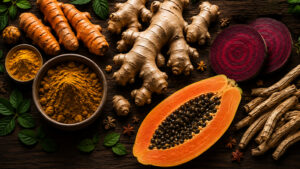
NaturMed Scientific applies this science through Fermiva, our dedicated platform for fermented botanical ingredients. Each Fermiva ingredient follows a controlled process: raw material is pulverised, fermented under defined temperature and time conditions, pasteurised, filtered, dried, and milled to a consistent particle size before packing. This process is applied across a growing portfolio that includes fermented turmeric, ashwagandha, ginger, beetroot, and papaya, among others. The rationale for fermenting each of these botanicals follows the mechanisms described above:
- Fermented turmeric is associated with higher levels of curcuminoids and phenolic compounds relative to unfermented turmeric.
- Fermented ashwagandha is positioned for increased adaptogenic and anti-inflammatory activity, consistent with the broader evidence on fermentation and anti-inflammatory properties.
- Fermented ginger is associated with enhanced antioxidant content and improved absorption.
- Fermented beetroot is positioned for improved bioavailability and functional properties.
- Fermented papaya is associated with increased antioxidant content and immune-modulating activity.
Across the range, the objective is consistent: to use a controlled fermentation process to increase the bioavailability and functional potential of well-established botanical raw materials, for use across dietary supplements, functional foods, sports nutrition, and cosmeceutical applications.
Note: The ingredients discussed in this article are food supplement ingredients, not licensed medicinal products, and are not intended to diagnose, treat, cure, or prevent any disease. Consumers with pre-existing health conditions or those taking medication are advised to consult a qualified healthcare professional before use.
References
Khayatan, D., Nouri, K., Momtaz, S., Roufogalis, B.D., Alidadi, M., Jamialahmadi, T., Abdolghaffari, A.H. and Sahebkar, A. (2024) ‘Plant-derived fermented products: an interesting concept for human health’, Current Developments in Nutrition, 8(5), article 102162. Available at: https://doi.org/10.1016/j.cdnut.2024.102162
Luo, X., Dong, M., Liu, J., Guo, N., Li, J., Shi, Y. and Yang, Y. (2024) ‘Fermentation: improvement of pharmacological effects and applications of botanical drugs’, Frontiers in Pharmacology, 15, article 1430238. Available at: https://doi.org/10.3389/fphar.2024.1430238
Shahbazi, R., Sharifzad, F., Bagheri, R., Alsadi, N., Yasavoli-Sharahi, H. and Matar, C. (2021) ‘Anti-inflammatory and immunomodulatory properties of fermented plant foods’, Nutrients, 13(5), article 1516. Available at: https://doi.org/10.3390/nu13051516
Yang, F., Chen, C., Ni, D., Yang, Y., Tian, J., Li, Y., Chen, S., Ye, X. and Wang, L. (2023) ‘Effects of fermentation on bioactivity and the composition of polyphenols contained in polyphenol-rich foods: a review’, Foods, 12(17), article 3315. Available at: https://doi.org/10.3390/foods12173315
Disclaimer: The Statement has not been evaluated by the EFSA, KFDA or FDA. This product is not intended to diagnose, treat, cure, or prevent any disease. While the information provided is based on credible references, we do not make any specific claims or guarantees. It is important to consult with your healthcare advisor for personalized advice and guidance related to your health.