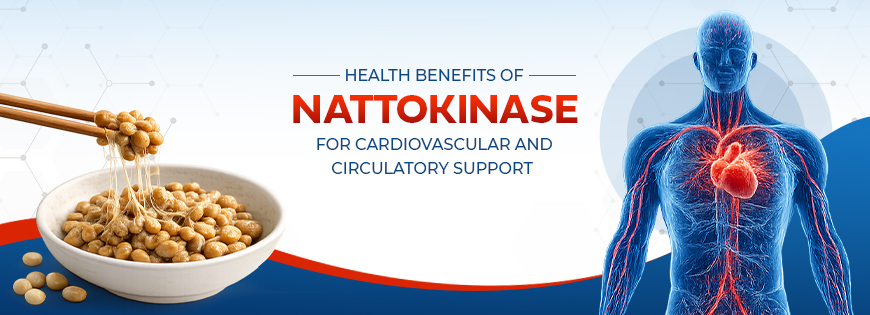
Nattokinase is a naturally occurring enzyme extracted from natto, a traditional Japanese food made by fermenting soybeans with Bacillus subtilis natto. It has gained scientific interest because of its potential role in supporting cardiovascular wellness, healthy blood flow, and normal circulation. Nattokinase is especially known for its fibrinolytic activity, meaning it may help support the body’s natural process of breaking down fibrin, a protein involved in blood clot formation.
Unlike many botanical ingredients, nattokinase is an enzyme-based functional ingredient. It has been studied for its possible effects on blood pressure, blood viscosity, clot-related markers, lipid metabolism, and vascular health. However, the available evidence is still developing, and results differ depending on dosage, study design, population, and duration. Below are several potential health benefits of nattokinase based on scientific research.

1. Supports Healthy Blood Flow and Fibrinolytic Activity
Nattokinase may support healthy circulation by helping the body maintain normal fibrin balance and natural clot breakdown mechanisms.
In a review titled Nattokinase: An Oral Antithrombotic Agent for the Prevention of Cardiovascular Disease, researchers described nattokinase as a fibrinolytic enzyme with potential cardiovascular-supportive properties. The review explains that nattokinase may help break down fibrin directly and may also support the body’s own fibrinolytic system by influencing plasmin and other clot-related pathways. These mechanisms suggest that nattokinase could play a role in supporting healthy blood flow and vascular function (Weng et al., 2017).
Also Read: Nattokinase’s Role in Heart Health and Risks to Know
Another review, Nattokinase: A Promising Alternative in Prevention and Treatment of Cardiovascular Diseases, discussed nattokinase as one of the most active components of natto. The authors highlighted its potential effects on fibrinolysis, blood pressure, lipid metabolism, and atherosclerosis-related markers. However, they also noted that more human studies are needed to confirm its clinical relevance, ideal dosage, and long-term safety in different populations (Chen et al., 2018).
2. May Help Maintain Healthy Blood Pressure
Nattokinase has been studied for its potential role in supporting normal blood pressure, particularly in people with elevated blood pressure ranges.
In a randomized, double-blind, placebo-controlled trial, researchers studied 86 adults aged 20 to 80 years with untreated systolic blood pressure between 130 and 159 mmHg. Participants received either nattokinase at 2,000 FU per day or a placebo for 8 weeks. Seventy-three participants completed the study. Compared with placebo, nattokinase was associated with reductions in systolic and diastolic blood pressure, with net changes of approximately -5.55 mmHg and -2.84 mmHg, respectively. The study also observed a reduction in plasma renin activity, suggesting a possible mechanism related to blood pressure regulation (Kim et al., 2008).
In another randomized, double-blind, placebo-controlled North American study, 79 participants with elevated blood pressure consumed either 100 mg nattokinase daily or placebo for 8 weeks. The study examined blood pressure and cardiovascular risk-related markers, including von Willebrand factor. The findings suggested that nattokinase consumption was associated with reduced blood pressure and a reduction in von Willebrand factor, a marker linked with vascular health and clotting activity (Jensen et al., 2016).
These studies suggest that nattokinase may support blood pressure balance in certain groups. However, it should not be considered a replacement for prescribed antihypertensive medication or medical care.
3. May Support Cardiovascular Risk Marker Balance
Nattokinase may help support cardiovascular wellness by influencing selected markers related to blood clotting, vessel function, and circulation.
The study by Jensen et al. (2016) is especially relevant because it did not only examine blood pressure but also measured von Willebrand factor and platelet factor-4. Von Willebrand factor is involved in platelet adhesion and clot formation. A reduction in this marker may suggest a supportive effect on vascular and circulatory balance. However, this does not mean nattokinase prevents cardiovascular events, as larger and longer clinical trials are required to confirm such outcomes (Jensen et al., 2016).
A 2023 systematic review and meta-analysis titled Nattokinase Supplementation and Cardiovascular Risk Factors evaluated randomized controlled trials on nattokinase and cardiovascular markers. The review found that nattokinase supplementation was associated with modest reductions in systolic and diastolic blood pressure. However, the authors also noted that evidence for other markers, including lipid and coagulation outcomes, was less consistent across studies (Li et al., 2023).
Overall, nattokinase may support selected cardiovascular markers, but its effects appear to depend on the study population, dose, product standardization, and duration of use.
4. May Help Support Lipid Metabolism and Arterial Health
Some studies suggest nattokinase may support lipid metabolism and arterial health, but the evidence is not fully consistent.
In a clinical study on carotid artery atherosclerosis and hyperlipidemia, nattokinase supplementation was investigated for its effect on carotid intima-media thickness, plaque size, and lipid profile. The findings suggested that nattokinase may reduce plaque-related measurements and improve certain lipid markers in participants with atherosclerosis and elevated lipids (Ren et al., 2017).
A later study examined a higher daily dose of nattokinase, 10,800 FU per day, in relation to atherosclerosis progression and hyperlipidemia. The researchers reported that this dose was associated with improvements in lipid profile and atherosclerosis-related measures. However, high-dose findings should not be generalized to all nattokinase products or standard supplement doses without careful evaluation (Chen et al., 2022).
At the same time, not all studies have shown positive results. The Nattokinase Atherothrombotic Prevention Study, a randomized controlled trial in healthy individuals at low cardiovascular risk, found that nattokinase supplementation did not significantly affect subclinical atherosclerosis progression, blood pressure, or laboratory markers after a median treatment period of 3 years (Hodis et al., 2021).
This contrast shows that nattokinase may be more relevant in selected populations, especially those with specific cardiovascular risk factors, rather than healthy low-risk individuals.
5. May Offer Support as Part of a Cardiometabolic Wellness Approach
Nattokinase is sometimes studied alongside other functional ingredients, particularly in cardiometabolic health research.
In a 2024 randomized, double-blind, placebo-controlled trial, researchers studied nattokinase combined with red yeast rice in patients with stable coronary artery disease. The study explored lipid-lowering, antihypertensive, and antithrombotic effects. The results suggested that the combination may improve certain cardiometabolic parameters, although it is important to note that this was a combination study. Therefore, the benefits cannot be attributed to nattokinase alone (Liu et al., 2024).
This type of research is important because cardiovascular health is influenced by many factors, including diet, physical activity, lipid levels, blood pressure, inflammation, oxidative stress, and genetics. Nattokinase may fit into a broader wellness strategy, but it should be positioned as a supportive ingredient rather than a standalone solution.
6. Generally Well Tolerated, but Care Is Needed
Nattokinase appears to be generally well tolerated in several human studies, but it requires responsible use due to its potential effect on blood clotting pathways.
A real-life clinical study evaluated nattokinase at 100 mg per day in patients admitted to vascular surgery. The researchers reported observations supporting the safety of nattokinase use in this setting, although individual medical supervision remains important, especially for people taking anticoagulant or antiplatelet medications (Gallelli et al., 2021).
Since nattokinase may influence fibrinolysis and clot-related markers, it may not be suitable for everyone. People taking blood thinners, aspirin, anticoagulants, or antiplatelet drugs, as well as those with bleeding disorders, upcoming surgery, pregnancy, or serious medical conditions, should seek medical advice before using nattokinase.
Nattokinase is a unique enzyme derived from fermented soybeans and is best known for its potential role in supporting cardiovascular and circulatory health. Its strongest areas of research include:
- Healthy blood flow support
- Fibrinolytic activity
- Blood pressure balance
- Vascular marker support
- Lipid metabolism and arterial health in selected populations
The available research is promising, but not completely consistent. Some studies show meaningful improvements in blood pressure, fibrinolytic activity, and cardiovascular markers, while others show limited or no effect, especially in healthy low-risk individuals. This suggests that nattokinase may work differently depending on individual health status, dose, duration, and product quality.
Nattokinase should be viewed as a supportive functional ingredient rather than a treatment or cure. When used responsibly, it may be a valuable addition to cardiovascular wellness formulations, especially those focused on circulation, healthy ageing, and metabolic balance.
Disclaimer: The statement has not been evaluated by the EFSA, KFDA or FDA. This product is not intended to diagnose, treat, cure, or prevent any disease. While the information provided is based on credible references, we do not make any specific claims or guarantees. It is important to consult with your healthcare advisor for personalized advice and guidance related to your health.
References
- Chen, H., McGowan, E.M., Ren, N., Lal, S., Nassif, N., Shad-Kaneez, F., Qu, X. and Lin, Y., 2018. Nattokinase: A promising alternative in prevention and treatment of cardiovascular diseases. Biomarker Insights, 13, pp.1–8.
- Chen, H., McGowan, E.M., Ren, N., Lal, S., Nassif, N., Shad-Kaneez, F., Qu, X. and Lin, Y., 2022. Effective management of atherosclerosis progress and hyperlipidemia with nattokinase. Frontiers in Cardiovascular Medicine.
- Gallelli, G., Cione, E., Caroleo, M.C., Carullo, G., Genchi, G., Rende, P. and Citraro, R., 2021. Data recorded in real life support the safety of nattokinase in patients with vascular diseases. Nutrients, 13(6), p.2031.
- Hodis, H.N., Mack, W.J., Dustin, L., Mahrer, P.R. and Azen, S.P., 2021. Nattokinase atherothrombotic prevention study: A randomized controlled trial. Clinical Hemorheology and Microcirculation, 78(4), pp.339–353.
- Jensen, G.S., Lenninger, M., Ero, M.P. and Benson, K.F., 2016. Consumption of nattokinase is associated with reduced blood pressure and von Willebrand factor, a cardiovascular risk marker: Results from a randomized, double-blind, placebo-controlled, multicenter North American clinical trial. Integrated Blood Pressure Control, 9, pp.95–104.
- Kim, J.Y., Gum, S.N., Paik, J.K., Lim, H.H., Kim, K.C., Ogasawara, K., Inoue, K., Park, S., Jang, Y. and Lee, J.H., 2008. Effects of nattokinase on blood pressure: A randomized, controlled trial. Hypertension Research, 31(8), pp.1583–1588.
- Li, X., Zheng, X., Liu, Y. and Zhang, Y., 2023. Nattokinase supplementation and cardiovascular risk factors: A systematic review and meta-analysis. Reviews in Cardiovascular Medicine, 24(8), p.234.
- Liu, M., Zhang, H., Wang, Y., Li, X. and Chen, J., 2024. Lipid-lowering, antihypertensive, and antithrombotic effects of nattokinase combined with red yeast rice in patients with stable coronary artery disease: A randomized, double-blinded, placebo-controlled trial. Frontiers in Nutrition.
- Ren, N.N., Chen, H.J., Li, Y., McGowan, E. and Lin, Y.G., 2017. A clinical study on the effect of nattokinase on carotid artery atherosclerosis and hyperlipidaemia. Zhonghua Yi Xue Za Zhi, 97(26), pp.2038–2042.
- Weng, Y., Yao, J., Sparks, S. and Wang, K.Y., 2017. Nattokinase: An oral antithrombotic agent for the prevention of cardiovascular disease. International Journal of Molecular Sciences, 18(3), p.523.