Few hormones have moved from obscure physiology textbooks into mainstream conversation as quickly as glucagon-like peptide-1 (GLP-1). Driven largely by the popularity of pharmaceutical GLP-1 receptor agonists, consumer interest in “GLP-1 support” has expanded rapidly into the food, beverage, and supplement space.
What Is GLP-1?
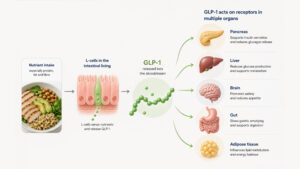
GLP-1 is a peptide hormone secreted by L-cells in the intestinal lining in response to nutrient intake, most notably after meals containing protein, fat, and fibre It belongs to a class of hormones known as incretins, which coordinate digestion with metabolic signalling. Once released, GLP-1 acts on receptors distributed across the pancreas, liver, brain, gut, and adipose tissue, giving it influence over several interconnected systems rather than a single pathway (Lotosky et al., 2025).
In the pancreas, GLP-1 enhances insulin secretion and supports beta-cell function. In the brain, it interacts with appetite centres to promote satiety and reduce food-seeking behaviour. In the gut, it slows gastric emptying, which extends the sensation of fullness after eating. Its actions in the liver and skeletal muscle, including support for glycogen synthesis and energy expenditure, are still being characterised but are considered relevant to its broader metabolic effects (Lotosky et al., 2025).
Also Read: Benefits of Milk Thistle for Liver and Blood Sugar
Because GLP-1 is broken down rapidly in the body by the enzyme dipeptidyl peptidase-4 (DPP-4), its natural signalling window is short. This is one of the reasons pharmaceutical GLP-1 receptor agonists were developed with modified structures resistant to DPP-4 degradation (Lotosky et al., 2025).
It is also the reason nutritional researchers have taken an interest in ingredients that may support the body’s own GLP-1 activity, either by encouraging its release or by inhibiting the enzyme that breaks it down.
GLP-1’s Role in Appetite Regulation

Appetite is not governed by a single signal but by a network of gut-brain communication, in which GLP-1 plays a coordinating role. Following a meal, elevated GLP-1 levels contribute to reduced hunger, slower gastric emptying, and increased feelings of fullness. This combination helps explain why GLP-1 has become a central focus in weight management research, both pharmaceutical and nutritional. Importantly, GLP-1 does not act in isolation; it interacts with other gut hormones, including ghrelin and peptide YY, as part of a broader appetite-regulating system.
GLP-1 and Metabolic Function
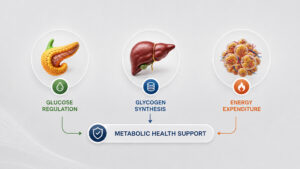
Beyond appetite, GLP-1-associated signalling has been linked to glucose regulation, lipid metabolism, and energy expenditure. In hepatic tissue, GLP-1 supports glycogen synthesis through both insulin-dependent and potential insulin-independent pathways. In adipose tissue, GLP-1 has been reported to stimulate brown adipose tissue thermogenesis and energy expenditure, a mechanism considered relevant to the weight loss associated with GLP-1 receptor agonist therapies (Lotosky et al., 2025).
These mechanisms remain an active area of investigation, and significant knowledge gaps are acknowledged in the literature, particularly regarding the extent of GLP-1’s direct effects in specific tissues.
Also Read: Liposomal Supplements: A New Era of Nutrient Absorption
Botanical Approaches to Supporting GLP-1 Pathways
A growing body of nutritional research has explored whether specific plant-derived extracts can influence endogenous GLP-1 activity, either through stimulating its secretion in the gut or by moderating DPP-4 activity, the enzyme responsible for GLP-1’s rapid breakdown. Interest in this area has accelerated alongside the wider GLP-1 conversation, with formulators increasingly looking to nutrition-based approaches that work through the same incretin pathway as pharmaceutical GLP-1 therapies, without being pharmaceutical products themselves.
One example from NaturMed Scientific’s own portfolio is Theolim, a standardised, patented combination of Key lime (Citrus aurantifolia) rind and cocoa (Theobroma cacao) seed extracts. Across a staged programme of preclinical and clinical research, Theolim has been evaluated for its effects on energy expenditure, body composition, and related metabolic markers. In cell and animal models, the combination was observed to support the expression of proteins associated with thermogenic activity, including uncoupling protein-1 and the beta-3 adrenergic receptor, to a greater degree than either source extract alone (Kundimi et al., 2024).
Human research has since progressed from an acute crossover trial, in which resting metabolic rate and fat oxidation were significantly higher following a single dose compared to placebo (Ammatalli et al., 2024), through to a 16-week randomised, double-blind, placebo-controlled trial in 120 overweight adults.
Also Read: Branded Ingredients
In that 16-week trial, Theolim supplementation was associated with significantly greater reductions in body weight and fat mass compared to placebo, alongside a mean 33% increase in serum GLP-1 from baseline at week 16, a significant reduction in ghrelin, and improvements in selected lipid and insulin-sensitivity markers (Chadalavada et al., 2025). This remains one of the more substantial pieces of human evidence to date linking a food-based botanical combination to endogenous GLP-1 activity, though independent replication and further characterisation of the biomarker changes would strengthen the evidence base.
Context and Limitations
While this area of research is expanding quickly, several caveats are worth noting. Much of the mechanistic evidence linking botanical ingredients to GLP-1 activity begins in cell and animal models, which cannot be directly extrapolated to human outcomes and are best understood as preliminary. Botanical GLP-1 research also does not expand the range of permitted structure-function claims for dietary supplements in most regulatory jurisdictions; it may, however, strengthen the underlying scientific rationale for existing claims around satiety, appetite regulation, and metabolic health. Formulators and brands are encouraged to position GLP-1-related botanical research as one part of a broader metabolic health narrative, rather than as a direct nutritional substitute for prescription GLP-1 therapies.
Note:The ingredients and studies discussed in this article are food supplement ingredients, not licensed medicinal products, and are not intended to diagnose, treat, cure, or prevent any disease. Consumers with pre-existing health conditions or those taking medication, including GLP-1 receptor agonist medications, are advised to consult a qualified healthcare professional before use.
References
Ammatalli, N.K.R., Kuricheti, S.S.S.K., Veeramachaneni, S., Koo, Y.K., Ramanathan, G. and Yalamanchi, A. (2024) ‘A combination of Citrus aurantifolia fruit rind and Theobroma cacao seed extracts supplementation enhances metabolic rates in overweight subjects: a randomized, placebo-controlled, cross-over study’, Food & Nutrition Research, 68, article 10745. Available at: https://doi.org/10.29219/fnr.v68.10745
Chadalavada, A., Koo, Y.K., Kim, S., Veeramachaneni, S., Ramanathan, G. and Yalamanchi, A. (2025) ‘A thermogenic botanical composition containing Citrus aurantifolia fruit rind and Theobroma cacao seed extracts improves body composition in overweight adults: a clinical investigation’, Food & Nutrition Research, 69, article 12159. Available at: https://doi.org/10.29219/fnr.v69.12159
Kundimi, S., Chinta, G., Alluri, K.V., Golakoti, T., Veeramachaneni, S., Ramanathan, G. and Sengupta, K. (2024) ‘A synergistic botanical composition increases resting energy expenditure and reduces adiposity in high-fat diet-fed rats’, Journal of the American Nutrition Association, 43(3), pp. 286–295. Available at: https://doi.org/10.1080/27697061.2023.2280777
Lotosky, J., Jean, X., Altankhuyag, A., Khan, S., Bernotas, A., Sharafshah, A., Blum, K., Posner, A. and Thanos, P.K. (2025) ‘GLP-1 and its role in glycogen production: a narrative review’, Biomedicines, 13(7), article 1610. Available at: https://doi.org/10.3390/biomedicines13071610
Disclaimer: The Statement has not been evaluated by the EFSA, KFDA or FDA. This product is not intended to diagnose, treat, cure, or prevent any disease. While the information provided is based on credible references, we do not make any specific claims or guarantees. It is important to consult with your healthcare advisor for personalized advice and guidance related to your health.