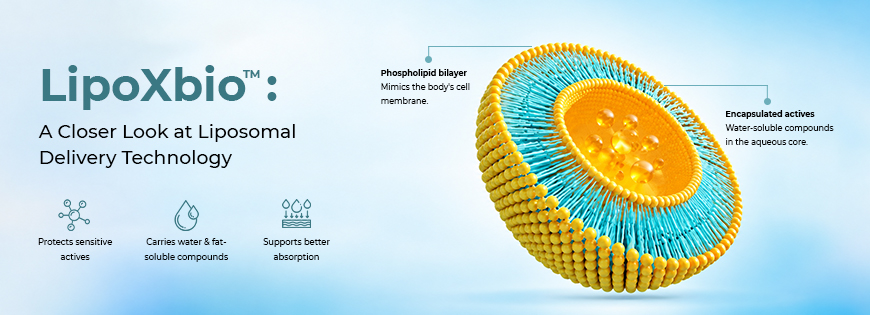
Some of the most researched compounds in nutraceutical science, from curcumin to CoQ10 to vitamin C, share a common obstacle: getting them into the bloodstream in meaningful amounts. Liposomal delivery is one of the technologies being used to address this, and it’s the science behind NaturMed Scientific’s LipoXbio™ platform.
Why Delivery Format Matters as Much as the Ingredient Itself
A supplement is only as effective as the amount of active compound that actually reaches circulation. Many valuable nutrients and botanicals are either broken down by stomach acid and digestive enzymes before they can be absorbed, or they simply don’t dissolve well enough in the gut to cross into the bloodstream in useful quantities. This is true even for well-established, well-studied ingredients; the compound itself may be sound, but the format it’s delivered in can significantly limit how much of it the body actually gets to use.
What a Liposome Actually Is
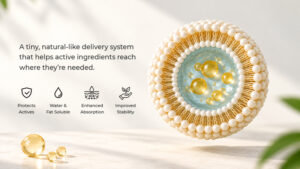
A liposome is a microscopic, spherical structure built from phospholipids, the same class of fat molecules that make up the membrane of every cell in the human body. Because of this structural similarity, liposomes are generally well tolerated by the digestive system and are able to encapsulate an active ingredient inside a protective bilayer. This matters for two reasons: the phospholipid shell can shield sensitive compounds from degradation as they pass through the stomach and intestines, and because the shell resembles a natural cell membrane, it can support more efficient uptake at the intestinal wall compared to an unprotected ingredient (Chen et al., 2024).
Liposomes are also unusual in that they can carry both water-soluble and fat-soluble compounds within the same structure, water-soluble molecules in the aqueous core, fat-soluble molecules within the lipid bilayer itself. This versatility is part of why the technology has been explored across a wide range of active ingredients, from vitamins and minerals to botanical extracts.
What the Research Shows
The clearest evidence for liposomal delivery tends to come from head-to-head bioavailability studies, comparing a liposomal form of an ingredient against its standard, unencapsulated equivalent. In one randomized, double-blind, placebo-controlled crossover trial, a liposomal vitamin C formulation produced a 27% higher peak plasma concentration and a 20% higher peak concentration within leukocytes (a type of white blood cell relevant to immune function) compared to standard, non-liposomal vitamin C at the same dose (Purpura et al., 2024). Because leukocytes rely on ascorbate for several of their functions, this kind of cellular-level uptake is considered a more meaningful marker than plasma levels alone.
It’s worth being precise about what this evidence does and doesn’t show. Bioavailability improvements are generally reported on a per-ingredient, per-formulation basis rather than as a fixed, universal multiplier that applies to any active compound placed inside a liposome. The magnitude of benefit depends on the specific ingredient, the liposome’s size and composition, and how the formulation is manufactured and stabilised.
LipoXbio™: NaturMed Scientific’s Delivery Platform
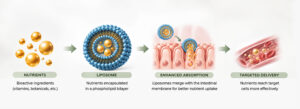
LipoXbio™ is NaturMed Scientific’s dedicated liposomal formulation platform, developed to apply this delivery science across the company’s wider ingredient portfolio rather than being tied to a single compound. LipoXbio™ addresses it through encapsulation and protection, offering formulators an alternative route to the same underlying goal: getting more of an active ingredient to where it needs to go in the body.
In practice, this means LipoXbio™-based formulations are built to:
- Protect sensitive actives from breakdown by stomach acid and digestive enzymes before absorption can occur.
- Support the delivery of both water- and fat-soluble ingredients, widening the range of compounds a single delivery format can accommodate.
- Improve formulation stability, which matters for ingredients that are otherwise prone to oxidation or degradation during shelf life.
- Enable lower effective doses for ingredients where standard bioavailability is a limiting factor, which can support easier formulation into capsules, powders, and liquid formats such as functional beverages and shots.
Context and Limitations
Liposomal delivery is a genuinely well-established area of pharmaceutical and nutraceutical science, but it is not a guarantee of improved outcomes for every ingredient. Some actives are already well absorbed in their standard form and gain little from encapsulation, while others require specific liposome sizes or compositions to see a meaningful benefit. Manufacturing quality also matters considerably: a poorly formulated or unstable liposome can lose its protective structure before reaching the small intestine, reducing the technology’s benefit for that batch. As with any delivery technology, the case for using it is strongest when it’s evaluated ingredient by ingredient, rather than assumed as a universal upgrade.
Note: The ingredients discussed in this article are food supplement ingredients, not licensed medicinal products, and are not intended to diagnose, treat, cure, or prevent any disease. Consumers with pre-existing health conditions or those taking medication are advised to consult a qualified healthcare professional before use.
References
Chen, J., Hu, S., Sun, M., Shi, J., Zhang, H., Yu, H. and Yang, Z. (2024) ‘Recent advances and clinical translation of liposomal delivery systems in cancer therapy’, European Journal of Pharmaceutical Sciences, 193, article 106688. Available at: https://doi.org/10.1016/j.ejps.2023.106688
Purpura, M., Jäger, R., Godavarthi, A., Bhaskarachar, D. and Tinsley, G.M. (2024) ‘Liposomal delivery enhances absorption of vitamin C into plasma and leukocytes: a double-blind, placebo-controlled, randomized trial’, European Journal of Nutrition, 63(8), pp. 3037–3046. Available at: https://doi.org/10.1007/s00394-024-03487-8
Disclaimer: The Statement has not been evaluated by the EFSA, KFDA or FDA. This product is not intended to diagnose, treat, cure, or prevent any disease. While the information provided is based on credible references, we do not make any specific claims or guarantees. It is important to consult with your healthcare advisor for personalized advice and guidance related to your health.