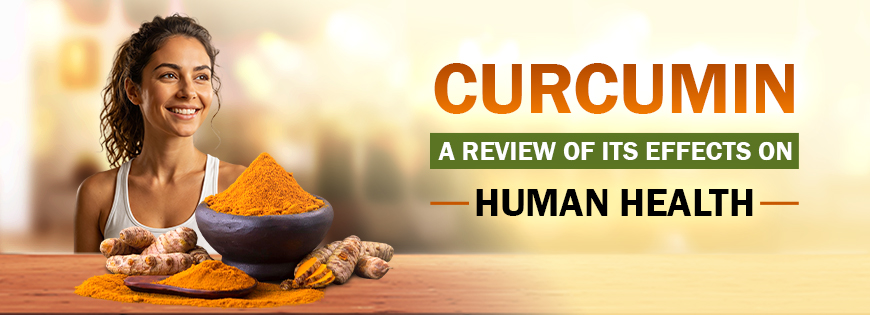
Curcumin is the principal bioactive compound found in turmeric (Curcuma longa), a botanical that has long been used in traditional food and wellness practices. In recent years, curcumin has attracted growing scientific interest because it may help support several aspects of human health, particularly those linked to inflammation, oxidative balance, joint comfort, metabolic function, and emotional well-being. However, while the research is encouraging, results may vary depending on the dose, formulation, duration of use, and the individual’s health condition.
Also Read: Turmeric Essential Oil (Curcuma longa)
Another important point is that curcumin is known to have relatively low natural bioavailability, which means that its absorption in the body may be limited unless it is delivered in enhanced forms or combined with other compounds such as piperine. Overall, current human evidence suggests that curcumin may offer supportive health benefits, but it is best interpreted as part of a broader lifestyle and nutrition approach rather than as a direct treatment for disease (Hewlings and Kalman, 2017).
1. Support for Inflammation Balance and Oxidative Stress
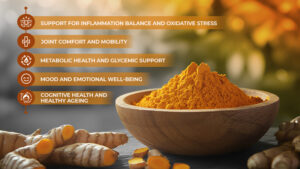
One of the most widely discussed areas of curcumin research is its potential role in helping the body manage inflammation and oxidative stress. These two processes are closely linked with long-term wellness and may influence many chronic health concerns.
2. Joint Comfort and Mobility
Curcumin may also be relevant in the area of joint health, especially for individuals experiencing discomfort linked with osteoarthritis. Several human studies suggest that curcumin might help support joint comfort and physical function, likely due to its interaction with inflammatory pathways. In a randomized double-blind placebo-controlled trial, Panahi and colleagues found that curcuminoid supplementation was associated with improved outcomes in people with knee osteoarthritis (Panahi et al., 2014a).
Also Read: Fermented Botanical Extracts and Powders: Enhanced Nature for Optimal Health
More recent clinical work has also suggested that standardized curcumin extracts may help reduce discomfort and improve mobility in individuals with knee osteoarthritis over time (Lopresti et al., 2021). Taken together, these findings indicate that curcumin may be a useful supportive ingredient in joint wellness products, although responses may differ depending on the formulation used and the severity of symptoms.
3. Metabolic Health and Glycemic Support
Another area where curcumin may show promise is metabolic health. Human studies suggest that curcumin might help support healthy lipid metabolism, glucose control, and insulin sensitivity in certain individuals, particularly those with metabolic disturbances.
In one randomized controlled trial, a curcuminoid-piperine combination was associated with favorable changes in serum lipid concentrations among patients with metabolic syndrome (Panahi et al., 2014b). A later systematic review and meta-analysis of randomized controlled trials concluded that turmeric and curcuminoids may help improve fasting blood glucose, HbA1c, and HOMA-IR in subjects with metabolic diseases (Yuan et al., 2022). These findings suggest that curcumin could be considered as part of a broader nutritional strategy for metabolic wellness, though it should not be viewed as a substitute for dietary management, physical activity, or medical care.
Also Read: Ginger: Health Benefits and Dietary Tips
4. Mood and Emotional Well-being
Curcumin has also been explored for its possible effects on mood and emotional health. This area of research is based on the understanding that inflammation, oxidative stress, and altered cell signaling may play a role in depressive symptoms in some individuals.
In a randomized, double-blind, placebo-controlled study, curcumin and its supplementation was associated with improvements in symptoms of major depression, particularly over longer periods of intervention (Lopresti et al., 2014). In addition, a meta-analysis examining curcumin for depression suggested that it may have beneficial effects as an adjunctive nutritional intervention, although the authors also noted the need for larger and more consistent trials (Fusar-Poli et al., 2020). This means curcumin might have value in formulations designed for holistic wellness and stress-support positioning, provided the language remains balanced and evidence-based.
Also Read: Lycopene in the Prevention of Cardiovascular Diseases
5. Cognitive Health and Healthy Ageing
Curcumin may also have potential in the area of cognitive support and healthy ageing. Because oxidative stress and inflammation are believed to influence age-related cognitive changes, researchers have explored whether curcumin could help maintain aspects of brain health.
In a randomized placebo-controlled study involving older adults, curcumin supplementation was investigated for its effect on cognition, adding to the growing human evidence in this field (Rainey-Smith et al., 2016).
A systematic review and meta-analysis also suggested that curcumin may have beneficial effects on cognitive function in certain groups, particularly older adults, although the results across studies were not entirely uniform (Zhu et al., 2019). This suggests that curcumin might support healthy ageing strategies, but more standardized clinical research is still needed before stronger conclusions can be drawn.
Limitations and formulation considerations
Although curcumin is associated with several promising areas of human health research, it is important to interpret the evidence carefully. One of the main challenges is its poor natural bioavailability, which may limit how much reaches systemic circulation after oral intake. As a result, different formulations may produce different outcomes, even when the active ingredient is described as curcumin.
Curcumin remains one of the most researched botanical compounds in the field of nutritional science. Current human studies suggest that it may help support inflammation balance, joint comfort, metabolic health, mood, and aspects of cognitive wellness. At the same time, the evidence should be presented with care, as outcomes may depend on formulation quality, absorption, dosage, and individual health context. For this reason, curcumin may be best positioned as a supportive botanical ingredient with promising clinical relevance, rather than as a definitive solution for any one condition. With balanced communication and evidence-led formulation, curcumin may continue to hold strong value in modern wellness and nutraceutical applications.
Disclaimer: The statement has not been evaluated by the EFSA, KFDA or FDA. This product is not intended to diagnose, treat, cure, or prevent any disease. While the information provided is based on credible references, we do not make any specific claims or guarantees. It is important to consult with your healthcare advisor for personalized advice and guidance related to your health.
References
- Fusar-Poli, L., Vozza, L., Gabbiadini, A., Vanella, A., Concas, I., Tinacci, S., Petralia, A., Signorelli, M.S. and Aguglia, E. (2020) ‘Curcumin for depression: a meta-analysis’, Critical Reviews in Food Science and Nutrition, 60(15), pp. 2643-2653.
- Hewlings, S.J. and Kalman, D.S. (2017) ‘Curcumin: A Review of Its Effects on Human Health’, Foods, 6(10), p. 92.
- Lopresti, A.L., Maes, M., Maker, G.L., Hood, S.D. and Drummond, P.D. (2014) ‘Curcumin for the treatment of major depression: A randomised, double-blind, placebo controlled study’, Journal of Affective Disorders, 167, pp. 368-375.
- Lopresti, A.L., Noonan, K., Liu, C. and Jefferson, A. (2021) ‘An Investigation into the Effects of a Curcumin Extract on Osteoarthritis Pain of the Knee: A Randomised, Double-Blind, Placebo-Controlled Study’, Nutrients, 13(12), p. 4174.
- Mantzorou, M., Pavlidou, E., Vasios, G., Tsagalioti, E. and Giaginis, C. (2018) ‘Effects of curcumin consumption on human chronic diseases: A narrative review of the most recent clinical data’, Phytotherapy Research, 32(6), pp. 957-975.
- Panahi, Y., Khalili, N., Hosseini, M.S., Abbasinazari, M. and Sahebkar, A. (2014a) ‘Curcuminoid treatment for knee osteoarthritis: a randomized double-blind placebo-controlled trial’, Phytotherapy Research, 28(11), pp. 1625-1631.
- Panahi, Y., Khalili, N., Hosseini, M.S., Abbasinazari, M. and Sahebkar, A. (2014b) ‘Lipid-modifying effects of adjunctive therapy with curcuminoids-piperine combination in patients with metabolic syndrome: Results of a randomized controlled trial’, Complementary Therapies in Medicine, 22(5), pp. 851-857.
- Panahi, Y., Hosseini, M.S., Khalili, N., Naimi, E., Majeed, M. and Sahebkar, A. (2015) ‘Antioxidant and anti-inflammatory effects of curcuminoid-piperine combination in subjects with metabolic syndrome: A randomized controlled trial and an updated meta-analysis’, Clinical Nutrition, 34(6), pp. 1101-1108.
- Rainey-Smith, S.R., Brown, B.M., Sohrabi, H.R., Shah, T., Goozee, K.G., Gupta, V.B. and Martins, R.N. (2016) ‘Curcumin and cognition: a randomised, placebo-controlled, double-blind study of community-dwelling older adults’, British Journal of Nutrition, 115(12), pp. 2106-2113.
- Yuan, F., Wu, W., Ma, L., Wang, D., Hu, M., Gong, J., Fang, K., Xu, L., Dong, H. and Lu, F. (2022) ‘Turmeric and curcuminoids ameliorate disorders of glycometabolism among subjects with metabolic diseases: A systematic review and meta-analysis of randomized controlled trials’, Pharmacological Research, 177, p. 106121.
- Zhu, L.-N., Mei, X., Zhang, Z.-G., Xie, Y.-P. and Lang, F. (2019) ‘Curcumin intervention for cognitive function in different types of people: A systematic review and meta-analysis’, Phytotherapy Research, 33(3), pp. 524-533.