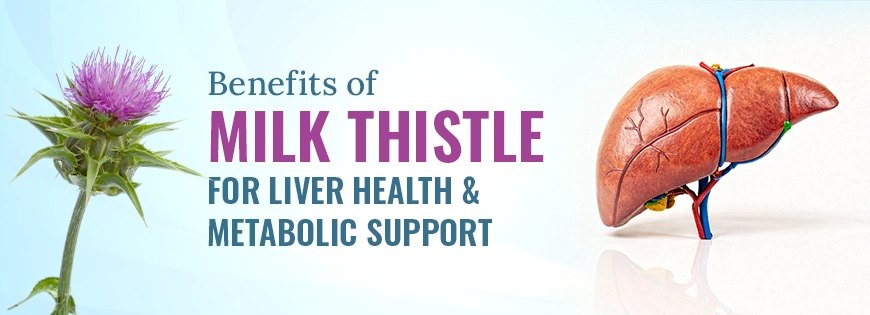
Milk thistle (Silybum marianum) is one of the most extensively studied herbal ingredients in modern world. Its active compound, silymarin, a mixture of flavonolignans including silybin, has been the focus of decades of clinical research. Below are several benefits of milk thistle.
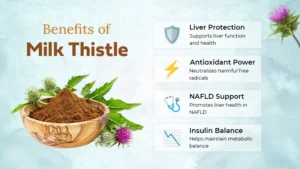
1. Supports Liver Function in Chronic Liver Disease
Milkthistle may consistently improve liver enzyme levels in people with chronic liver conditions.
In a study, Milk Thistle: Effects on Liver Disease and Cirrhosis and Clinical Adverse Effects, researchers conducted a systematic review of human clinical trials evaluating milk thistle (Silybum marianum) for various liver diseases. The findings suggest milk thistle may offer hepatoprotective benefits, including improvements in select liver function markers and possible survival advantages in certain patient subgroups, while overall demonstrating a favorable safety profile with mostly mild and infrequent adverse effects (Mulrow et al., 2000).
In another study, milk thistle was examined for its safety and effectiveness in treating chronic liver disease through a systematic review of 14 randomized controlled trials. Results showed that milk thistle was generally safe and well tolerated but did not significantly reduce mortality, improve liver biopsy findings, or enhance most biochemical liver markers. A small reduction in alanine aminotransferase was observed, though it was clinically negligible and not significant in higher-quality or longer studies. Overall, current evidence does not support recommending milk thistle as an effective treatment for liver disease (Jacobs et al., 2002).
2. Acts as a Powerful Antioxidant in Humans
Silymarin may significantly increase antioxidant activity and reduce oxidative stress markers in human studies.
In this study, researchers reviewed many previous studies to understand how silymarin helps reduce inflammation in the body. They found that silymarin can calm inflammation by blocking harmful chemicals and signals that cause swelling, pain, and tissue damage. It also works as an antioxidant, helping to protect cells from damage.
The review shows that silymarin may be helpful in several conditions linked to inflammation, such as liver disease, skin problems, diabetes, side effects of cancer treatment, and some immune-related conditions. Importantly, silymarin was generally found to be safe and well tolerated, with very few side effects reported.
The authors conclude that silymarin is a promising natural option for managing inflammation, but more large clinical studies are needed to confirm its benefits in everyday medical use (Zhao et al., 2024).
3. Improves Liver Health in Non-Alcoholic Fatty Liver Disease (NAFLD)
Milk thistle extract may protect the liver, reducing fat, inflammation, and oxidative stress, offering potential benefits for NAFLD.
In a study, researchers investigated whether milk thistle (MT) extract could protect rabbits from liver damage caused by thermally oxidized tallow, a type of fat linked to non-alcoholic fatty liver disease (NAFLD). Over 14 days, rabbits were fed oxidized tallow with or without MT extract. The study measured liver structure, blood lipids, antioxidant enzymes, and inflammatory markers.
Results showed that MT reduced fat accumulation in the liver, improved blood cholesterol levels, boosted antioxidants, and lowered inflammation. These findings suggest MT has protective effects on the liver and may help prevent NAFLD caused by dietary oxidized fats (Neelab et al., 2024).
4. Improves Insulin Resistance in Certain Populations
Silymarin, a milk thistle extract, may support insulin sensitivity and liver health, with potential benefits for glucose and lipid metabolism.
In a study, silymarin, was shown to improve insulin resistance and support liver health. Its main component, silybin, has antioxidant and anti-inflammatory effects that help the body respond better to insulin, lower blood sugar, and reduce harmful fats in the liver.
Animal and human studies found that silymarin can improve pancreatic function, decrease glucose and insulin levels, and reduce liver fat, especially in conditions like type 2 diabetes and NAFLD. Formulations that increase silymarin’s absorption, such as phytosomes or combinations with vitamin E, make it even more effective (MacDonald-Ramos et al., 2021).
Milk thistle is one of the few herbal supplements with credible, human-based scientific support, particularly for liver health. Its benefits are protective and supportive rather than curative, and its strongest evidence lies in:
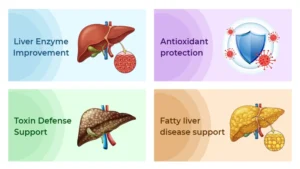
- Liver enzyme improvement
- Antioxidant protection
- Toxin-related liver injury
- Fatty liver disease support
Silymarin has been studied for its effects on liver health, blood sugar, and insulin resistance. Different studies used different doses, forms, and combinations, so results are not always the same. Some people showed clear improvements, while others had smaller or no changes.
Factors like diet, weight, genetics, and other medications may affect how well silymarin works. Overall, it seems to help support metabolism and liver function, especially when used along with lifestyle changes.
Silymarin appears to be safe and may help improve insulin resistance and liver health. While research shows some positive effects, results are not consistent in all cases. More studies are needed to find the best dose, form, and combinations for different people. It could be used as a supportive treatment alongside standard care for metabolic or liver-related problems.
When used responsibly and with realistic expectations, milk thistle stands out as a rare example of an herbal remedy where traditional use aligns closely with modern clinical science.
Disclaimer: The Statement has not been evaluated by the EFSA, KFDA or FDA. This product is not intended to diagnose, treat, cure, or prevent any disease. While the information provided is based on credible references, we do not make any specific claims or guarantees. It is important to consult with your healthcare advisor for personalized advice and guidance related to your health.
References:
- Mulrow, C., Lawrence, V., Jacobs, B., Dennehy, C., Sapp, J., Ramirez, G., Aguilar, C., Montgomery, K., Morbidoni, L., Arterburn, J.M., Chiquette, E., Harris, M., Mullins, D., Vickers, A. and Flora, K., 2000. Milk Thistle: Effects on Liver Disease and Cirrhosis and Clinical Adverse Effects. Evidence Report/Technology Assessment No. 21. Agency for Healthcare Research and Quality, Rockville, MD.
- Zhao, Y., Zhou, Y., Gong, T., Liu, Z., Yang, W., Xiong, Y., Xiao, D., Cifuentes, A., Ibáñez, E. and Lu, W., 2024. The clinical anti-inflammatory effects and underlying mechanisms of silymarin. iScience, 27(11), 111109.
- Jacobs, B.P., Dennehy, C., Ramirez, G., Sapp, J. & Lawrence, V.A., 2002. Milk thistle for the treatment of liver disease: A systematic review and meta-analysis. The American Journal of Medicine, 113(6), pp.506–515.
- Neelab, N., Zeb, A. & Jamil, M., 2024. Milk thistle protects against non-alcoholic fatty liver disease induced by dietary thermally oxidized tallow. Heliyon, 10(10), p.e31445. doi:10.1016/j.heliyon.2024.e31445.
- MacDonald-Ramos, K., Michán, L., Martínez-Ibarra, A. & Cerbón, M., 2021. Silymarin is an ally against insulin resistance: A review. Annals of Hepatology, 23, 100255.