Green tea is one of the most popular natural drinks in the world. Many people believe it helps protect the heart and lowers the risk of heart disease. But is this really true, or is it just a myth? Let’s look at what science says in simple terms.
What Is Heart Disease?
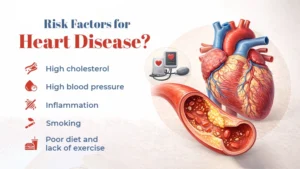
Heart disease usually happens when blood vessels that supply the heart become narrow or blocked. This can be caused by:
- High cholesterol
- High blood pressure
- Inflammation
- Smoking
- Poor diet and lack of exercise
Anything that lowers these risks may help protect heart health.
What Makes Green Tea Special?

Green tea is rich in natural compounds called antioxidants, especially one known as catechins (Epigallocatechin-3-gallate EGCG). These compounds help protect the body from damage caused by free radicals and inflammation, both linked to heart disease.
Also Read: Avoid These Green Tea Mistakes to Unlock Its Full Potential
What Science Shows (Facts)
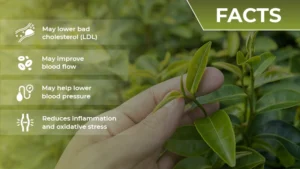
Research suggests that drinking green tea regularly may support heart health in several ways:
1. May lower bad cholesterol (LDL):
Some studies show green tea can slightly reduce cholesterol levels.
Green tea intake lowers fasting serum total and LDL cholesterol in adults: a meta-analysis of 14 randomized controlled trials evaluated 14 RCTs involving 1,136 adults to assess the effects of green tea beverages or extracts on lipid profiles. The analysis found significant reductions in total cholesterol (−7.20 mg/dL) and LDL cholesterol (−2.19 mg/dL), with no significant effect on HDL cholesterol. Results were consistent across doses, durations, populations, and study quality.
Also Read: 10 Health Benefits of Green Tea Extract
2. May improve blood flow:
Green tea helps blood vessels relax and work better.
In a study researchers tested green tea extract in 12 healthy older adults. They found that green tea extract improved blood flow in thigh muscle after a meal, but it did not significantly change muscle glucose uptake, insulin response, or brain blood flow, suggesting better circulation without metabolic changes.
Also Read: Supplement and Herb Guide for Arthritis Symptoms
3. May help lower blood pressure:
Small reductions in blood pressure have been seen in regular green tea drinkers.
A study reviewed 24 randomized controlled trials with 1,697 adults to examine the effects of green tea on blood pressure. Participants took green tea or green tea extract for 3–16 weeks. Overall, green tea slightly lowered systolic blood pressure by 1.17 mm Hg and diastolic blood pressure by 1.24 mm Hg compared to placebo. The blood pressure-lowering effect was stronger in people with high-normal or hypertensive blood pressure and those at cardiovascular risk. Caffeine in green tea did not significantly affect results. Green tea appears safe and may help reduce blood pressure, but longer, larger studies are needed.
4. Reduces inflammation and oxidative stress:
These are key factors in heart disease development.
In a double-blind, placebo-controlled study examined 56 obese, hypertensive patients who received 379 mg of green tea extract (GTE) daily for 3 months. GTE supplementation significantly reduced systolic and diastolic blood pressure, fasting glucose, insulin levels, and insulin resistance. It also lowered inflammatory markers (CRP and TNF-α), improved total antioxidant status, decreased total and LDL cholesterol and triglycerides, and increased HDL cholesterol. The study demonstrates that daily GTE intake can improve blood pressure, insulin resistance, inflammation, oxidative stress, and lipid profiles in patients with obesity-related hypertension.
What Green Tea Cannot Do (Myth)
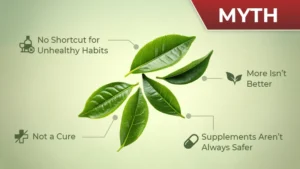
Green tea is helpful, but it is not magic:
- It cannot prevent heart disease on its own.
- It does not cancel out unhealthy habits like smoking or eating too much processed food.
- Drinking more does not mean better results.
- Green tea supplements are not always safe or more effective than brewed tea.
How Much Green Tea Is Beneficial?
Most research suggests 2 to 4 cups per day may offer benefits. It’s best to drink green tea without sugar, as sugar can increase heart disease risk.
Final Verdict: Fact or Myth?
Fact, with balance.
In another systematic review and meta-analysis examined 55 randomized clinical trials to evaluate the effects of green tea supplementation on cardiovascular risk factors. Results showed that green tea extract significantly lowered total cholesterol, LDL cholesterol, fasting blood sugar, HbA1c, and diastolic blood pressure, while increasing HDL cholesterol. Subgroup analyses suggested that the effects may vary with supplementation duration, dose, sex, and baseline health status. Overall, the study supports green tea as a beneficial supplement for improving lipid and blood sugar profiles and reducing cardiovascular risk.
Green tea may help lower the risk of heart disease, but only as part of a healthy lifestyle. Its benefits are gentle and supportive, not a cure. Think of green tea as a natural ally, not a replacement for healthy living.
In conclusion, green tea may play a supportive role in reducing the risk of heart disease due to its natural antioxidants and anti-inflammatory properties. Scientific studies suggest that regular consumption can help improve cholesterol levels, support healthy blood vessels, and slightly lower blood pressure. However, green tea is not a cure and should not be relied on alone for heart protection. Its benefits are most effective when combined with a balanced diet, regular exercise, and healthy lifestyle choices. Including green tea as part of daily wellness habits can be a simple and natural way to support overall heart health.
Disclaimer:The Statement has not been evaluated by the EFSA, KFDA or FDA. This product is not intended to diagnose, treat, cure, or prevent any disease. While the information provided is based on credible references, we do not make any specific claims or guarantees. It is important to consult with your healthcare advisor for personalized advice and guidance related to your health.
References:
- Bogdanski, P., Suliburska, J., Szulinska, M., Stepien, M., Pupek‑Musialik, D. & Jablecka, A. (2012) ‘Green tea extract reduces blood pressure, inflammatory biomarkers, and oxidative stress and improves parameters associated with insulin resistance in obese, hypertensive patients’, Nutrition Research, 32(6), pp. 421–427. Available at: Green tea extract reduces blood pressure
- Din, U.S.U., Sian, T.S., Deane, C.S., Smith, K., Gates, A., Lund, J.N., Williams, J.P., Rueda, R., Pereira, S.L., Atherton, P.J. & Phillips, B.E. (2021) ‘Green tea extract concurrent with an oral nutritional supplement acutely enhances muscle microvascular blood flow without altering leg glucose uptake in healthy older adults’, Nutrients, 13(11), p. 3895. Available at: Green Tea Extract Concurrent with an Oral Nutritional Supplement… (Nutrients).
- Xin‑Xin, Z., Yan‑Lu, X., Shao‑Hua, L., Xu‑Xia, L., Rutai, H. & Xiao‑Hong, H. (2011) ‘Green tea intake lowers fasting serum total and LDL cholesterol in adults: a meta‑analysis of 14 randomized controlled trials’, The American Journal of Clinical Nutrition, 94(2), pp. 601–610. Available at: Green tea intake lowers fasting serum total and LDL
- Xu, R., Yang, K., Ding, J. & Chen, G. (2020) ‘Effect of green tea supplementation on blood pressure: A systematic review and meta‑analysis of randomized controlled trials’, Medicine (Baltimore), 99(6), p. e19047. Available at: Effect of green tea supplementation on blood pressure
- Zamani, M., Rezaei Kelishadi, M., Ashtary‑Larky, D., Amirani, N., Goudarzi, K., Attackpour Torki, I., Bagheri, R., Ghanavati, M. & Asbaghi, O. (2023) ‘The effects of green tea supplementation on cardiovascular risk factors: A systematic review and meta‑analysis’, Frontiers in Nutrition, 9, p. 1084455. Available at: The effects of green tea supplementation on cardiovascular risk factors